Services

Consulting from the team that engineers its own greenhouse technology.

We don't review greenhouse and cannabis projects from a textbook. The expertise behind Active Air Insulation™ and our rotary growing systems — climate physics, energy loads, structures, controls, crop science — is the same expertise we put on your project.

QUOTED PER PROJECT — NO RATE CARD FIXED QUOTES SCOPE BACK IN ≤5 BUSINESS DAYS NDA ON REQUEST

Technical Expertise

Five domains. One integrated building.

A greenhouse is a single physics problem — climate, energy, structure, light, water, controls, and crop all pushing on each other. Pick a domain to see how we read it.

VPD TARGET ZONE 22°C · 68% RH TEMPERATURE → HUMIDITY → HEAT · COOL · LOAD · ILLUSTRATIVE — NOT PROJECT DATA
AIR CAVITY GROWING SPACE CONTINUOUS CAVITY — ROOF + WALLS DOUBLE-SHELL SECTION GLAZING · INSULATION · ILLUSTRATIVE — NOT PROJECT DATA
SPECTRAL POWER DISTRIBUTION SRC: LED · 3.1 µmol/J λ 660 · PEAK 380440500560620680780 PAR 400–700 nm — MEASURED SPD --- ACTION CURVE + HEAT LOAD 42% DLI 17.4 mol·m⁻²·d⁻¹ TARGET 24 REF: PAR SENSOR · CANOPY HEIGHT 1.2 m · 16 h PHOTOPERIOD LIGHT · WATER · NUTRIENTS · ILLUSTRATIVE — NOT PROJECT DATA
CONTROL LOOP SENSE DECIDE ACT SENSE · DECIDE · ACT · ILLUSTRATIVE — NOT PROJECT DATA
GERMVEGMATUREHARVEST BIOMASS → GREENHOUSE & CANNABIS · ILLUSTRATIVE — NOT PROJECT DATA

Climate, Energy & HVAC

Temperature, humidity, energy, and air movement are one coupled system. We size heating, cooling, dehumidification, and distribution to hold the crop’s VPD target — and model the load that drives the operating bill.

VPD TargetingDehumidificationAir DistributionHourly Load ModelOperating Cost

Structures & Envelopes

Structure, glazing, and insulation decide both light transmission and heat loss. We review buildability and envelope performance — the discipline behind Active Air Insulation™, which we engineer and fabricate ourselves.

Structural ConceptGlazing SystemsInsulation StrategyLight TransmissionBuildability

Lighting, Irrigation & Inputs

The inputs that drive the crop: spectrum and DLI from the lighting, water and nutrients from fertigation. We design each — and account for how light adds heat and how dosing holds EC and pH.

DLI & SpectrumFixture LayoutPrecision DosingEC / pH ControlWater Efficiency

Controls, Automation & Data

Sensors and controllers are only useful if they drive decisions. We review control-system fit, sensor placement, and alarm logic — and turn operating data into action.

Control-System FitSensor StrategyAlarm LogicData PipelinesOperator Dashboards

Crop Science & Cultivation

The environment exists to serve the crop. We align climate, light, and irrigation to the production plan across greenhouse food crops and licensed cannabis — including room-level HVAC-D and technical risk.
Crop-Environment FitProduction PlanningRoom-Level HVAC-DYield ModelingTechnical Risk
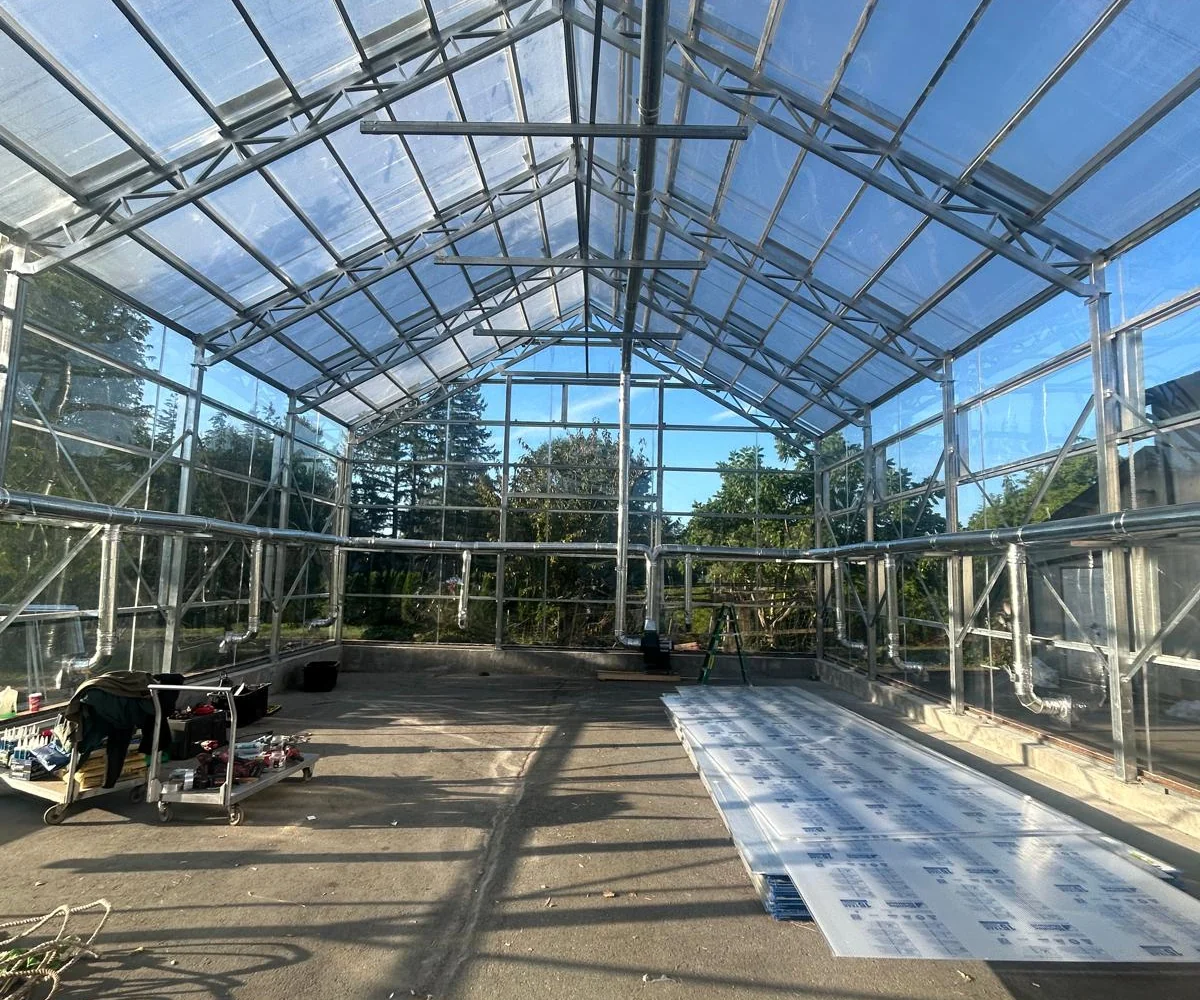
Interior of Revo 9's AAI greenhouse during field assembly

Built-project perspective

The advisory starts where drawings meet the field.

Revo 9's team has taken its own AAI greenhouse and rotary system through modelling, fabrication, field assembly, and pilot planning. That experience changes the review: we look for the interfaces, access constraints, control gaps, and operating assumptions that are easy to miss on paper.

MODELLINGFABRICATIONFIELD ASSEMBLYPILOT OPERATIONS

The Service Ladder

Start small. Scale the engagement to the decision.

Most clients begin with a fast, low-commitment review of what they already have, then deepen the engagement as the project — and the money at stake — grows.

COMMITMENT & DEPTH →CLICK A STAGE TO SEE ITS SERVICES
STAGE 1

Quick answers — days to two weeks

≈1 WEEK

Rapid Technical Screening

A fast read of what you already have — what holds up, what’s missing.

Red-flag memo + next step.
1–2 WEEKS

Vendor & Quote Comparison

Competing proposals compared side by side.

Comparison matrix + negotiation points.
2–3 WEEKS

Technical Due Diligence

An independent check of feasibility and vendor claims before you commit.

Go / fix / no-go report.
STAGE 2

The full picture — three to six weeks

3–5 WEEKS

Concept Review

Layout, climate, lighting, irrigation, and controls — reviewed before design locks in.

Gaps + prioritized fixes.
2–4 WEEKS

Risk Assessment

What could go wrong — ranked, with a fix for each.

Risk register + checkpoints.
3–4 WEEKS

Energy & Climate Feasibility Study

Heating and cooling loads, and whether an efficient envelope pencils out.

Load model + cost scenarios.

Need all three? The Combined Technical Review bundles them into one engagement — one integrated report, 4–6 weeks.

STAGE 3

Ongoing support — monthly advisory

Advisory Lite

MONTHLY
TOUCHPOINTS / MO

Monthly dashboard + alarm review and one support call.

Best fit: Pilots & small sites.

Performance Advisory

BIWEEKLY
TOUCHPOINTS / MO

Biweekly review, KPI tracking, and optimization guidance.

Best fit: Growing commercial facilities.

Managed Technical Advisory

WEEKLY
TOUCHPOINTS / MO

Weekly review, priority support, and operator coaching.

Best fit: Complex or multi-site operators.
STAGE 4

Build with us — from advisory to deployment

Retrofit planning & Revo 9 technology deployment

When a review points to the envelope or the growing system itself, we can carry the project further: retrofit screening and upgrade planning for existing facilities, and deployment planning for Active Air Insulation™ greenhouses and Rotary Growing Towers — from concept sizing through pilot partnership.

Explore the technology
ON INDEPENDENCE

We sell our own greenhouse technology, so we say this plainly: advisory engagements are quoted, delivered, and paid for on their own terms, and a review never recommends Revo 9 hardware as a condition of anything. If a conventional envelope or another vendor's system is the right answer for your project, the report says so — in writing. Where a recommendation would involve our own products, we disclose it in the deliverable and you are free to take the report to any supplier.

What You Receive

Every engagement ends in a written, defensible document.

SAMPLE REPORT — CONTENTS18–40 PP · PDF
01Executive summary & verdictgo / fix / no-go
02Scope, documents reviewed & assumptionstraceable
03Findings by systemclimate · envelope · light · water · controls
04Crop–environment alignmentproduction plan
05Energy & operating-cost viewload model
06Risk register, ranked with mitigationsowner actions
07Prioritized recommendations & next checkpointsequenced

A redacted sample report is available on request before you commit to an engagement.

Plain Language

The terms our reports use, in one place.

VPDVapour pressure deficit — how thirsty the air is. It drives transpiration, and holding it in range is most of climate control.
DLIDaily light integral — the total usable light a crop receives per day. The number that decides whether you need supplemental lighting.
PARThe 400–700 nm band of light plants actually photosynthesize with.
HVAC-DHeating, ventilation, air conditioning and dehumidification, sized as one system — standard practice in cannabis rooms.
FertigationDelivering water and dissolved nutrients together, controlled to target EC (nutrient strength) and pH.
CEAControlled-environment agriculture — greenhouses and indoor farms where climate is actively managed.
TRLTechnology readiness level, 1–9. TRL 5 means validated as a working prototype in a relevant real-world setting.

Questions We Answer

If you're asking one of these, there's a service for it.

?
Is this greenhouse or cultivation concept technically sound?
→ Concept Review
?
Do the proposed systems match the crop and production strategy?
→ Concept Review
?
Are the vendor claims, budgets, and performance assumptions credible?
→ Technical Due Diligence
?
Which of these competing vendor quotes should we actually sign?
→ Vendor & Quote Comparison
?
What will this facility really cost to heat and cool?
→ Energy & Climate Feasibility Study
?
What are the biggest risks before capital is committed?
→ Risk Assessment
?
Why is our existing facility underperforming — and what do we fix first?
→ Rapid Screening → Retrofit Planning
?
Can an independent specialist review this project for our investors or board?
→ Due Diligence · Combined Review
?
Can our operating team get ongoing expert support without a full-time hire?
→ Remote Advisory
?
Could an energy-efficient envelope or rotary system change our economics?
→ Feasibility Study → Deployment

Not Sure Which Fits?

Send what you have.
We'll name the right scope.

Submit the intake form with whatever documents exist and we'll recommend the correct service with a fixed quote, within five business days — no discovery call needed. Everything you share is held in confidence.

ONLINE INTAKE + DOCUMENT UPLOAD · NDA AVAILABLE BEFORE YOU UPLOAD ANYTHING